
Exogenous ketones: what are they, and what are they for?
You know that afternoon energy dip. The mental fog. The feeling of running on the wrong fuel. What if your body had a second one — cleaner, steadier?
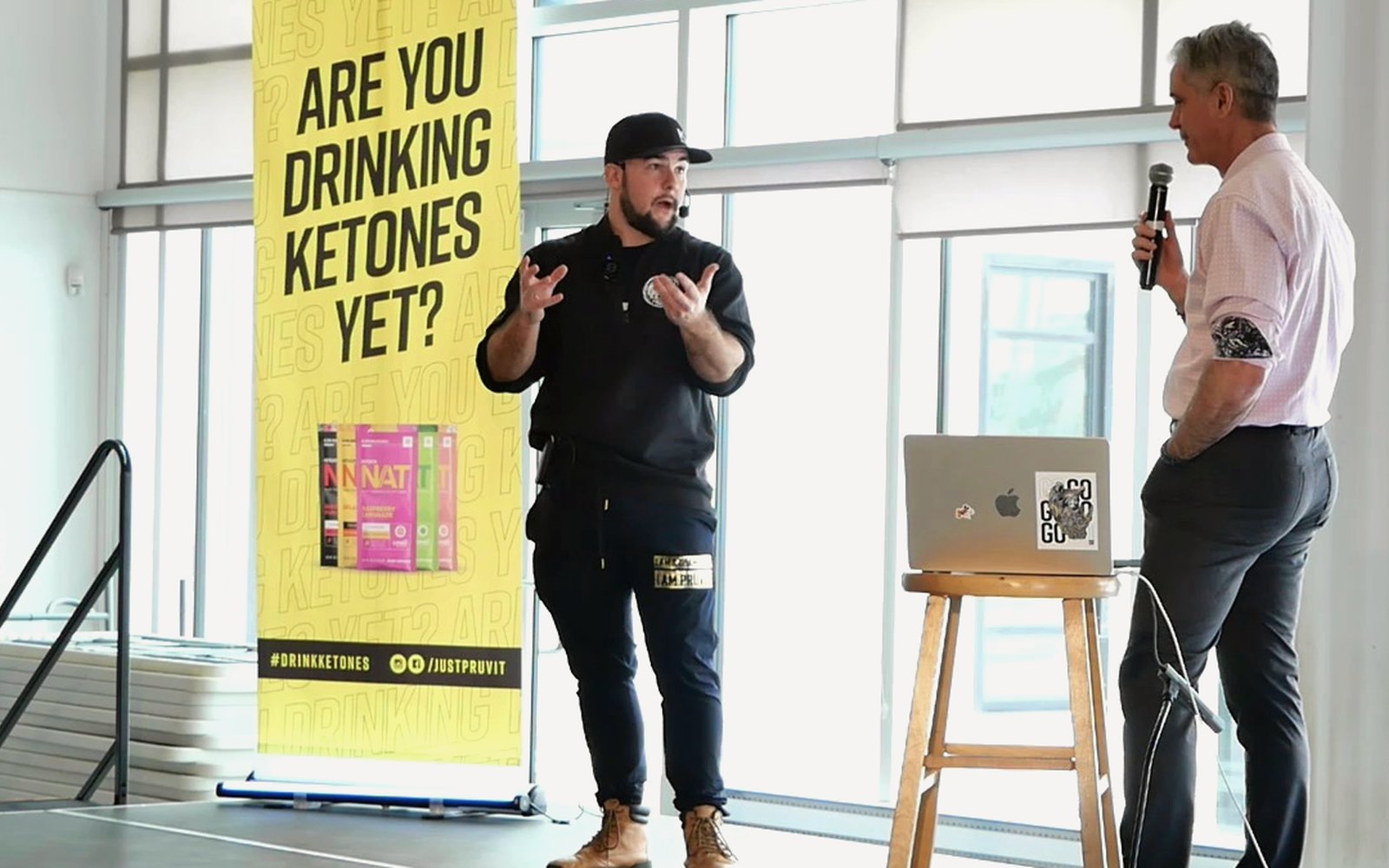
- Your body has two fuels: sugar, and ketones.
- Exogenous ketones are BHB you drink. Thirty minutes later, it's in your blood — no strict diet, no fasting.
- BHB isn't just a fuel: it's a molecule that talks to your body. Six signals, further down.
- The real effect, you feel it on day five. Not on day one.
I got interested in the human body at 15, for a simple reason: my father couldn't move anymore. Arthritis, inflammation. Ever since, I've been studying food, the body, and energy. I've read a lot of books, tested things on myself, and taught this to thousands of people. This piece is what I've been repeating for eight years in my webinars, finally put down in writing, once and for all. Keep it, come back to it.
What is a ketone?
When you run low on carbs, your liver makes ketones out of your fat. The main one is called BHB — beta-hydroxybutyrate (I dedicate a whole article to it). Written keto or ceto, with a K or a C, it's the same thing: English or French. No more confusion.
Why do you want ketones in your blood? Because your body loves ketones. The brain, the body in general: if you want more energy, more focus, you want them in your blood. You can survive a very long time without — but if you're here, it's because you want more than just surviving.
The catch: to make them yourself, you have to cut carbs for days. That's where exogenous ketones come in. "Exogenous" just means "coming from outside." And it's the same beta-hydroxybutyrate — the exact one your liver makes.
I'll be honest with you: I did strict keto for a very long time. I had great results. But I'm human. There are moments when I feel like rewarding myself, and if I keep up a lifestyle that strict for a month, six months, two years, I'm bound to fall off. That's exactly why you need to know all three roads, not just the first one.
Ketosis: three roads
Being in ketosis is simple: it's when your body becomes a machine that burns fat and uses it. It's measurable — above 0.5 mmol/L in the blood — but you don't have to measure it (the signs that you're in ketosis). There are three ways to get there:
- The ketogenic diet — very few carbs, day after day. It works. It's the keto religion: if you're here to run the marathon all the way through, perfect.
- Fasting — the body pulls its own fat and turns it into ketones. That's why you feel mentally good when you fast.
- Exogenous ketones — BHB directly, in thirty minutes. That's the third road, and it's the one that changes the game for regular people.
The goal isn't to pick one. The goal is to be able to do both: an endogenous production — your own — and an exogenous one. We use all three, each in its place.
Endogenous or exogenous?
| Diet / fasting (endogenous) | Exogenous ketones | |
|---|---|---|
| Time | 2 to 7 days | About 30 minutes |
| Effort | Dietary discipline | A glass of water |
| Flexibility | Low | High — on demand |
The two complement each other. Exogenous ketones don't replace good eating. Me, I drink them and produce them endogenously at the same time — both at once. And once you feel the difference, you want to keep going. Is that part clear?
BHB: the molecule that talks
I've been talking about this for ten years, and it's the piece people retain the least, because it's the most technical. BHB isn't just a fuel. It's a signaling molecule: it tells your body things. Six signals, in the order I teach them.
- Energy regulation. Whether you're keto or not, when glucose is low, ketones speed up fat-burning to turn it into ketones. So if there's BHB in your system, you produce more. The more ketones there are, the more the body ramps up its fat-burning machine. For the people who say you lose less fat with ketones: this first point right here proves them wrong.
- Gene expression. BHB acts on gene switches. In other words, it changes what your cells decide to build.
- Inflammation and immune response. BHB acts positively on a factor called NLRP3 — a signal that tells the body to produce inflammation. Careful with what I'm saying here: I'm not saying ketones cure inflammation. I'm saying BHB acts positively on that factor, and that it helps stabilize inflammation. I'm not a doctor, I'm not a physician: I'm just showing you where the science is going.
- Metabolic regulation. With BHB circulating, insulin sensitivity improves. In other words: you handle carbs better, you handle your fat better — storing it, releasing it. And you're not hungry all the time. You're hungry at the right time.
- BDNF. BHB increases production of brain-derived neurotrophic factor. Basically, that's what largely regulates your mood, the health of your neurons, and, long term, good cognitive function.
- Lipid metabolism. An improvement in your lipid profile, in how your body handles fat. It can even influence cholesterol levels in the blood — and don't take my word for it: go read.
A fuel gets burned. A signal changes the machine. BHB does both at the same time.
What you'll feel — and when
Some people take ketones once or twice and feel nothing. Not positive, not negative: nothing. Normal. Usually, it's on day five of consistent use that you feel the effect.
Why five days? Picture this: you've got thousands and thousands of mitochondria inside you. Think of the mitochondria as your energy factories. All those factories were running on sugar. And now, overnight, you're bringing them a completely different energy source. Your body understands there's something new going on, and it makes changes across all its cells. That takes a few days.
So if you feel changes in the first few days — even weird ones, what's called the keto flu — that's a positive sign. It means your body is changing. What people are looking for, and what they find most often:
- Steady energy — no more 3 p.m. slump.
- Focus — less mental fog.
- Fewer cravings — less desire for cookies, less desire for sugar.
- Good mood — even with the in-laws.
- Sleep — sleeping like a baby.
Results vary from person to person. It's a tool, not a magic wand.
For those who train
The most interesting thing about exogenous ketones, for performance, is that you use less oxygen for the same amount of energy. Which gives you better recovery. And better muscle retention: no matter how much you over-train, you've got a stubborn tendency to hold on to your muscle mass instead of burning it.
Me, I don't do that much elite-level stuff. I focus on optimizing a mass of ordinary people — the dad, the mom who runs, the entrepreneur who doesn't sleep enough. But the principles are the same, from the wannabe hockey player all the way to the athlete.
What exogenous ketones are not
- "It stops your body from making its own ketones." False. Eight years ago, I asked myself that same question. The answer is no: your body keeps producing them, and the exogenous ones just add to that.
- "It's a free pass to eat whatever you want." No. It's a tool that makes the change easier to feel, and so easier to stick with. (Benefits and myths, in detail.)
- "It cures a disease." No. There are correlations in the research — I read them, I teach them — but that's not how it works, and I'm not the one who's going to promise you that.
Frequently asked questions
Do you have to follow a keto diet to take them?
No. Exogenous ketones deliver BHB directly, no matter how you eat. That's exactly what sets them apart from the ketogenic diet.
Does it break a fast?
Me, I drink them and produce them endogenously at the same time — both at once. Fasting and exogenous ketones aren't an either-or.
When do I take them?
Consistently, every day, for at least five days before you judge. It's on day five that you feel the effect.
And if I have a health condition?
I'm not a doctor. If you have a condition, if you're taking medication, talk to your doctor first.

I've been studying nutrition, the body, and human energy since I was 15. How you feel first, the science to back it up. Who is Mick